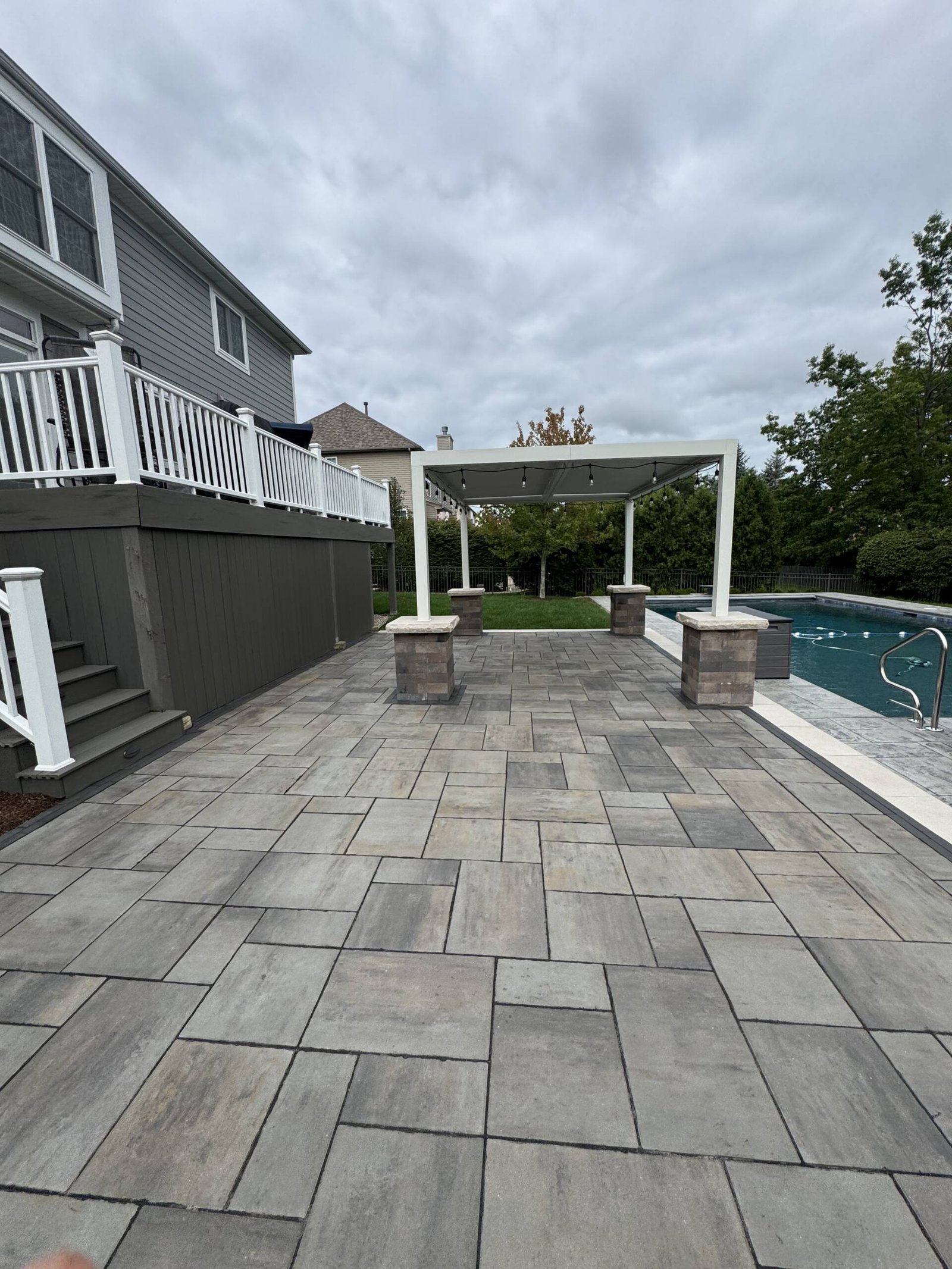
Thinking About Replacing Your Patio? See Why Pavers Outlast, Outperform, and Outshine Poured Concrete In Illinois Climate.
From winter durability to resale value, here are the 3 biggest reasons Northern IL homeowners are tearing out concrete and installing pavers instead.
Your Concrete Patio Didn't Fail - It Was Always Going to
Every Illinois winter, the ground under your patio freezes, swells, and settles back down dozens of times – and a rigid concrete slab has only one way to respond: crack. A paver patio is the opposite by design: hundreds of dense, individually set stones on a compacted gravel base, each able to flex a fraction and settle back while the joints absorb the movement. Pavers even shrug off the de-icing salt that eats away at poured concrete. Same climate, same frozen ground – completely different outcome.
When Concrete Fails, You Re-Pour. When a Paver Shifts, You Re-Set It.
When a concrete patio cracks or settles, your repair options are ugly: patch it and live with a visible scar, or re-pour sections that will never match – and most of the time the honest answer is full replacement. Pavers break that cycle entirely. If a section ever settles, we lift the affected pavers, re-level the base, and set them right back in place. That’s why paver patios routinely last 30 to 40+ years in our climate, while poured concrete starts showing serious problems in a third of that time.
Better Looks Now, Better Value When Replacing a Concrete Patio with Pavers
When a concrete patio cracks or settles, your repair options are ugly: patch it and live with a visible scar, or re-pour sections that will never match – and most of the time the honest answer is full replacement. Pavers break that cycle entirely. If a section ever settles, we lift the affected pavers, re-level the base, and set them right back in place. That’s why paver patios routinely last 30 to 40+ years in our climate, while poured concrete starts showing serious problems in a third of that time.
The Bottom Linne
If your concrete patio is cracked, sunken, or stained, replacing it with more concrete just restarts the same clock. Pavers are engineered for exactly the conditions that destroyed your slab in the first place – the freeze-thaw movement, the salts, the moisture – and they give you repairability, design freedom, and resale value that poured concrete simply can’t match.
That’s why homeowners across Northern Illinois and Southern Wisconsin keep making the same switch. Once you go from concrete to pavers, you never look back.
Start Your Project
Ready to see what your backyard could look like?
We design every project in 3D before the first stone is laid, so you see exactly what you're getting. Serving Northern IL & Southern WI.